 Job Prosperity
GUIDE
An interview preparation workflow you can repeat for every role
Turn confirmed logistics and role research into focused preparation, useful questions, and a clear post-interview record.
Good interview preparation is less about predicting every question than building a reliable way to retrieve relevant evidence. A repeatable workflow helps you verify logistics, understand the role, select examples, and arrive with questions that support your own decision. It also prevents preparation from expanding to fill every available hour.
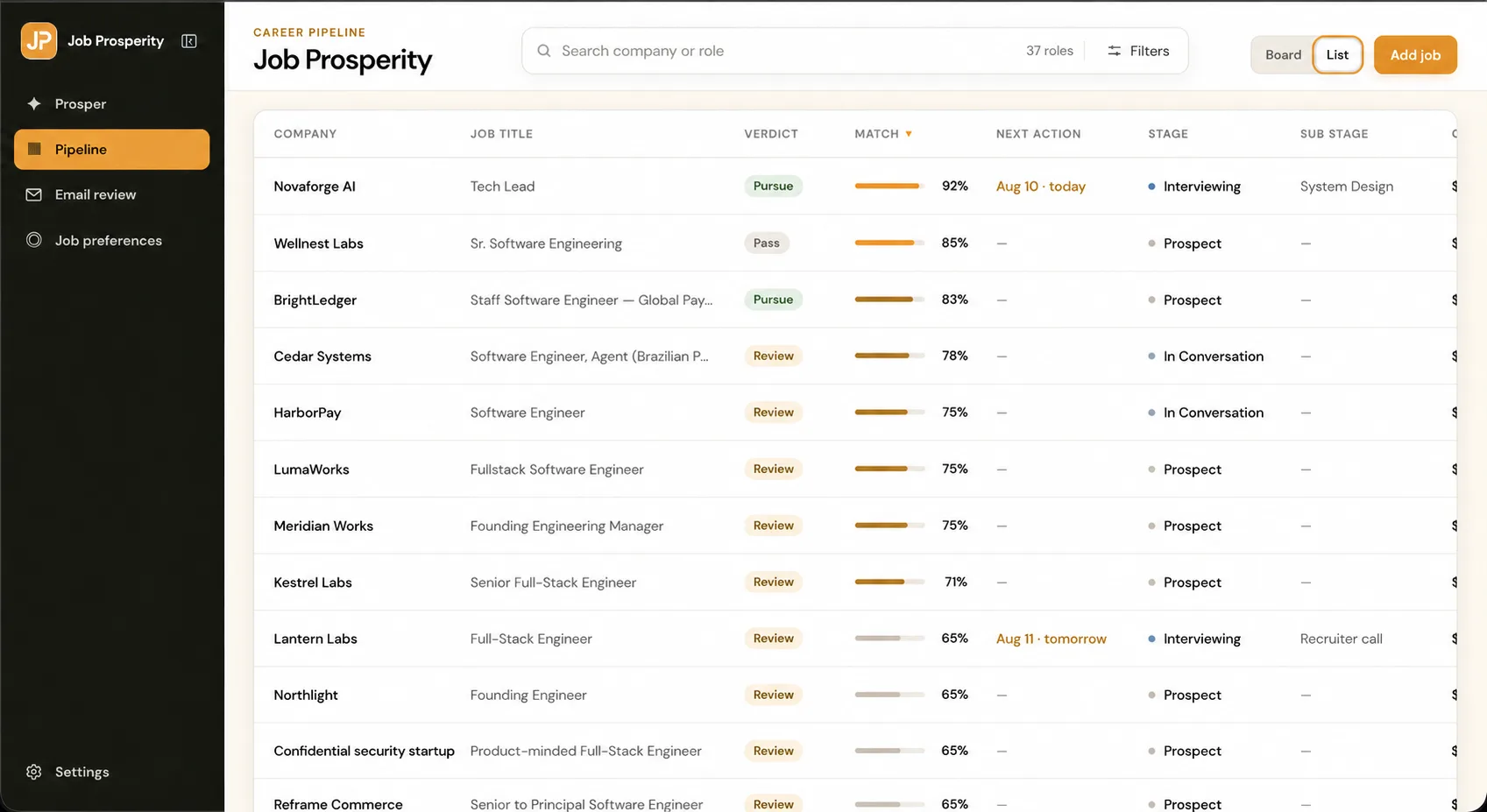
Use the original invitation and job description as sources of truth. Job Prosperity can keep those references, notes, and next actions connected in an interview tracker, but it does not generate interview preparation or guarantee that event details were inferred correctly.
Confirm the interview before preparing
| Check | Question to answer | Source |
|---|---|---|
| Time | What is the date, time, duration, and time zone? | Invitation or recruiter confirmation |
| Format | Video, phone, onsite, presentation, or assessment? | Invitation and scheduling notes |
| People | Who is confirmed, and what are their roles? | Invitation and company profiles |
| Materials | Is anything requested in advance? | Recruiter message |
| Access | Does the link, location, or contact method work? | Calendar event and direct test |
If a detail is missing, ask the recruiting contact rather than guessing. Record the confirmed facts with the opportunity and add “confirm interview format” as a next action when necessary. The optional Gmail tracker can help associate the relevant invitation, but the source message remains authoritative.
Turn the role description into a preparation map
Read the description once for the overall problem, then again for repeated capabilities, outcomes, and constraints. Group requirements into three to five themes such as stakeholder leadership, analytical depth, customer discovery, or technical execution. Do not treat every bullet as equally important; repeated and outcome-oriented language usually deserves attention.
For each theme, write what the employer appears to need, what evidence you can offer, and what you still want to learn. Separate a verified fact from an inference. “The role reports to the VP of Product” may be stated; “the team lacks a planning process” is only a hypothesis unless the employer confirms it.
Select a small evidence library
Choose three to five examples from your experience that cover the central themes. For each, note the situation, your responsibility, the actions you personally took, the result, and what you learned. Quantify results only when you can explain the measurement. A precise, modest fact is stronger than a dramatic number you cannot defend.
Practice retrieving the examples in different forms rather than memorizing a script. One project may demonstrate prioritization, conflict resolution, and execution depending on the question. Prepare a concise opening, the key decision, and the result; allow the conversation to determine which detail matters.
Prepare questions that improve your decision
Your questions should reveal the work, expectations, and environment. Ask what success looks like in the first months, which problems are most urgent, how decisions are made, and what distinguishes effective collaboration on the team. Adapt questions to the interviewer’s likely perspective instead of reading the same list to everyone.
Avoid questions answered clearly on the public website unless you use the answer to go deeper. Keep a short backup list, but prioritize genuine uncertainties about the role. The interview is evidence for your choice as well as the employer’s.
Use a time-boxed checklist
- Two or more days before: verify logistics and map the role themes.
- One day before: select evidence and prepare interviewer-specific questions.
- Before the meeting: test access, close distractions, and review a one-page outline.
- During the meeting: listen for new facts, timelines, and open questions.
- Immediately after: capture concise notes before memory fades.
- Later that day: decide the next action and when to review the role again.
Time boxes prevent endless research. A recruiter screen may need a shorter preparation block than a final presentation. Increase effort when the format or stakes change, not simply because anxiety asks for more tabs.
Close the loop after the conversation
Record who attended, the topics discussed, new facts about the work, concerns to investigate, and any timeline the employer provided. Update the stage only when the event supports it. Then choose one next action: send a message you write yourself, deliver requested material, prepare for the next confirmed stage, or wait until a stated review date.
The follow-up tracker keeps that intention and context visible but does not draft or send the message. Use the application tracking routine to review the opportunity alongside the rest of your search, and archive it when continued attention no longer makes sense.
This workflow cannot guarantee an interview outcome, but it can make your preparation more consistent and your notes more useful. Keep private context concise, verify facts at the source, and review the security and privacy boundaries before deciding what belongs in any career workspace.
After several interviews, review the workflow itself. Keep the prompts that reliably surface useful evidence and retire steps that produce pages of unused notes. Compare your original role hypotheses with what interviewers actually explained. That reflection can sharpen questions for later stages and help you decide whether the opportunity still matches your constraints, without pretending that a small number of conversations is a universal hiring pattern.
Archive reusable examples separately from employer-specific notes. Your evidence library can improve over time, while private scheduling details and recruiting conversations remain attached only to the relevant opportunity.