 Job Prosperity
INTERVIEW TRACKER
Keep every interview stage connected to the opportunity
Organize confirmed logistics, preparation notes, people, and follow-up decisions without losing the wider application history.
Interview preparation becomes harder when the job description is in one tab, the invitation is in Gmail, and your notes live in several documents. An interview tracker gives each conversation a home inside the opportunity record. It should make the confirmed facts easy to find and leave enough room for your own research and judgment.
Job Prosperity does not claim to generate interview preparation or infer every event correctly. It helps you organize the stage, connected messages, notes, and next action so your preparation workflow stays grounded in information you have reviewed.
Define stages that change your preparation
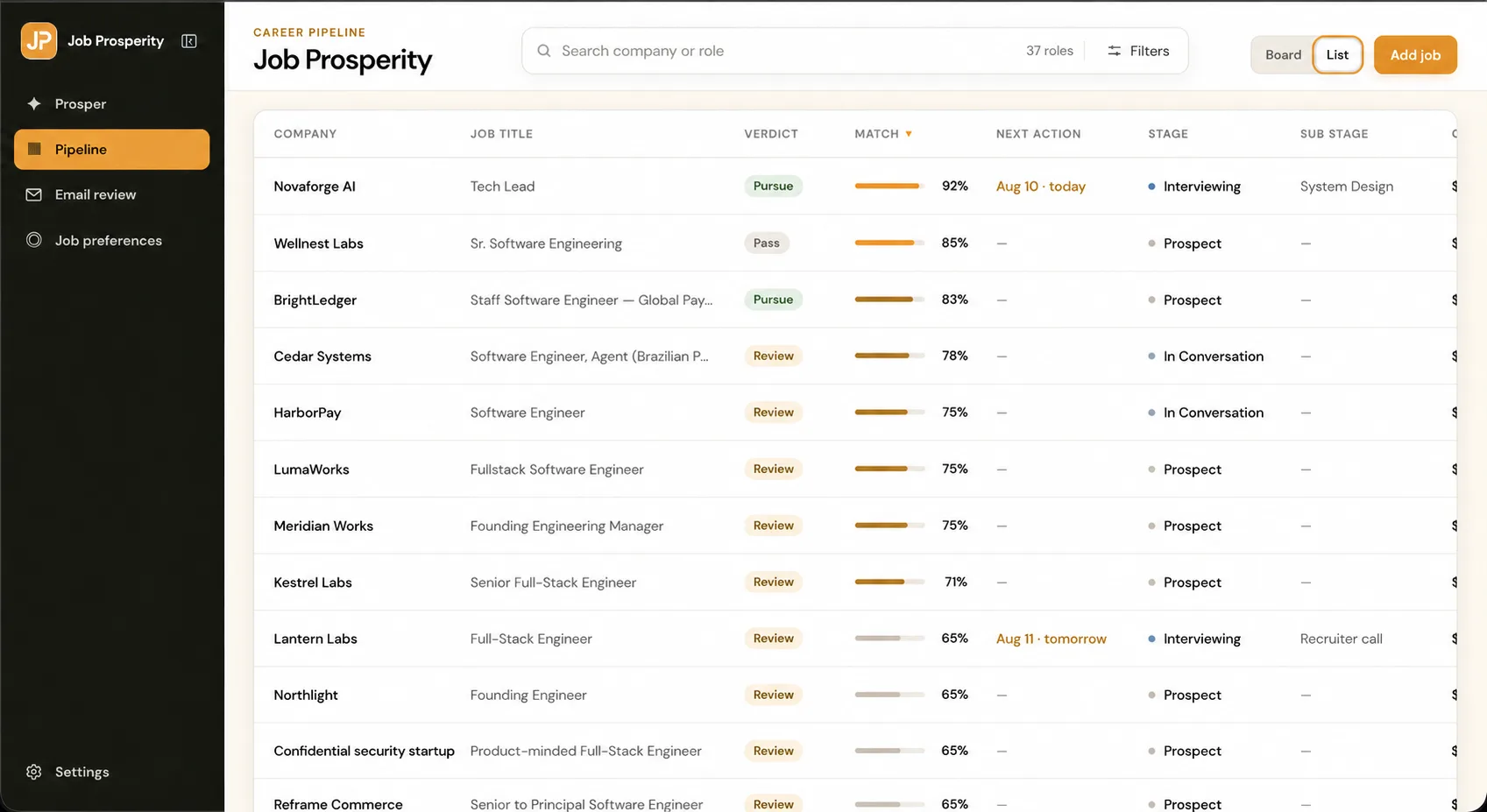
A practical sequence could include recruiter screen, hiring-manager interview, assessment, interview loop, and decision. Use separate stages only when they call for different work. For example, an assessment may require a delivery plan, while a panel interview may require stories that work for several perspectives.
Keep the overall opportunity in your application pipeline. The interview stage is part of that history, not a separate project. The guide to pipeline stages shows how to prevent overlapping labels.
Capture logistics from the original source
Record the date, time zone, format, location or meeting link, and known participants. Verify each detail against the invitation instead of copying assumptions into the tracker. If you use the optional Gmail connection, relevant invitations can be reviewed alongside the opportunity, but Gmail remains the source of truth.
Add a next action that is small enough to complete: confirm attendance, research the interviewer, choose two project examples, test the meeting link, or prepare questions. A vague task such as “prepare” is difficult to start and impossible to evaluate.
Use one repeatable preparation checklist
A consistent checklist reduces anxiety and makes preparation easier to scope. Re-read the role, identify the problems the team appears to be solving, select evidence from your experience, and prepare questions that reveal how the work is actually done. Separate verified company facts from your hypotheses.
The interview preparation workflow provides a reusable checklist for the days before a conversation. Store concise notes with the opportunity; keep long writing in the document system you already trust.
Finish the interview with a clear record
After the conversation, note the people you met, the themes discussed, open questions, and any timeline the employer stated. Then choose the next action. That might be sending a message you write yourself, completing an assignment, waiting until a stated date, or deciding the role no longer fits.
If you plan to contact someone later, use the follow-up tracker to preserve the reason and review date. Job Prosperity does not send messages on your behalf. Review the security overview before deciding what information belongs in a private career workspace.
Review preparation across roles rather than starting from zero each time. A reusable checklist can cover logistics, role themes, evidence, questions, and access testing, while the substance stays specific to the employer. After each conversation, note which examples were useful and which questions remain unresolved. That record supports your next interview and your own evaluation of the opportunity; it is not a prediction of what an interviewer will ask.
When an interview changes, update the confirmed time and your next action together. Remove obsolete links from the immediate checklist, retain only the history you need, and test the new access details. Clear current information is safer than several competing versions of the schedule.
Frequently asked questions
What interview stages should I track?
Use only stages that change your work: recruiter screen, hiring-manager conversation, assessment, interview loop, and decision are a practical starting set.
What belongs in interview notes?
Capture confirmed logistics, the people involved, questions to research, examples to prepare, and the follow-up you intend to make. Avoid storing unnecessary sensitive information.
Does Job Prosperity generate interview preparation?
No. It keeps your opportunity context and notes together so you can run your own preparation workflow.
How do I avoid missing a follow-up?
Before closing an interview session, record one explicit next action and a realistic due date. Review that field alongside your active pipeline.